
Richardson’s New Short-Term Rental Pause: What Landlords Need to Know Before August 25, 2026
For Richardson landlords considering short-term rentals, August 25, 2026, is an important date to keep on the calendar.
The City of Richardson is currently operating under a temporary 90-day prohibition on the approval of new short-term rental (STR) registrations in certain residential districts. The pause began May 27 and is scheduled to expire August 25, 2026.
For landlords, this temporary measure is more than a deadline. It signals that Richardson is taking a closer look at how short-term rentals affect residential neighborhoods—and that future rules could change.
Here's what property owners need to know.
What Is a Short-Term Rental in Richardson?
Richardson defines a short-term rental as all or part of a dwelling offered for compensation for fewer than 30 consecutive days. This can include a single-family home, guest house, garage apartment, condominium, apartment unit, or a room within one of these properties.
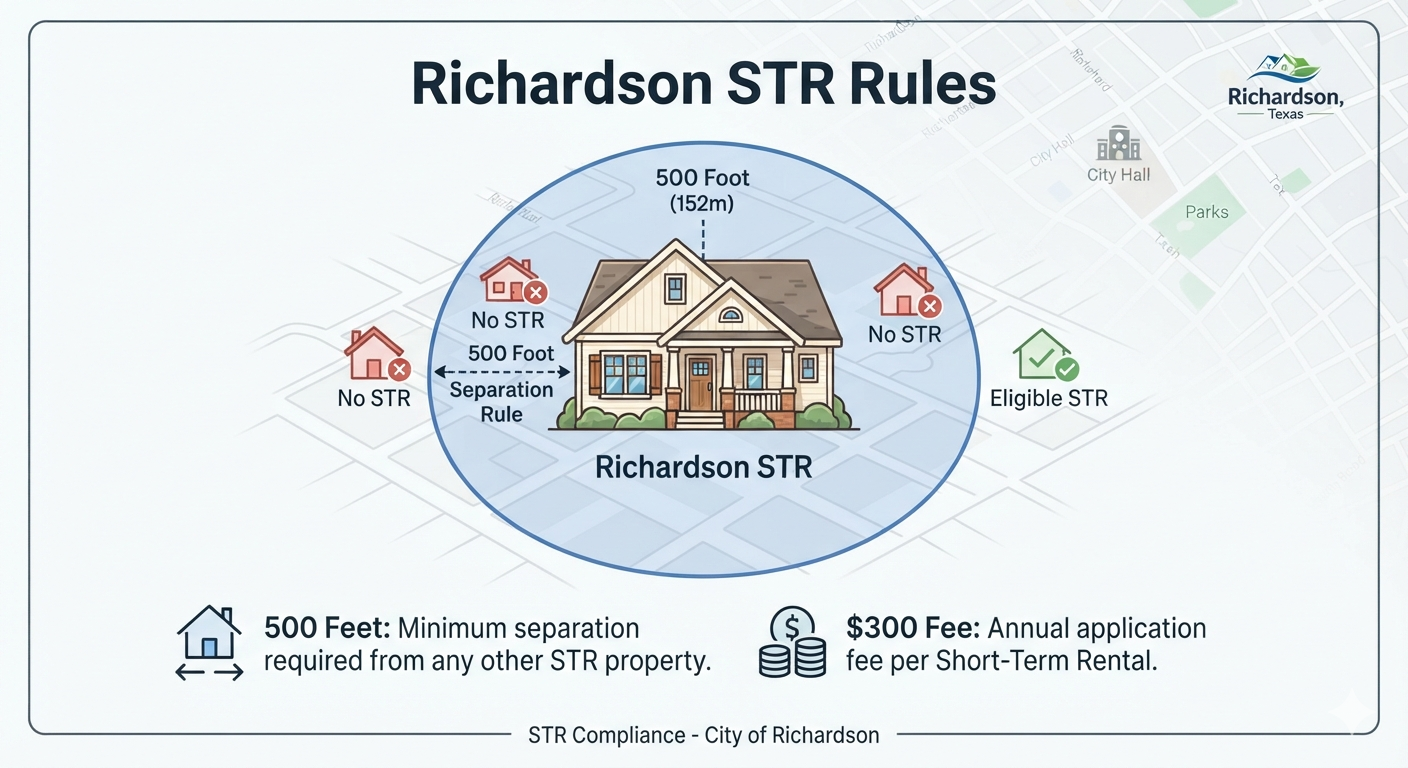
The city has required STR registration since 2022, with annual registration and a $100 registration fee. Registration applications include information about the property owner, operator, management or agents, emergency contacts, and the platforms used to advertise the rental.
Why Did Richardson Pause New STR Registrations?
The temporary prohibition was adopted after city officials received concerns from residents about the impact of short-term rentals on residential neighborhoods.
The city specifically cited concerns involving:
- Potential clustering of STR properties
- Disruptive gatherings
- Parking impacts
- Noise
- Trash
- Neighborhood health, safety, and welfare
Richardson officials are using the 90-day period to conduct additional public outreach, collect data, and study STR operations and their concentration in neighborhoods.
The city is also trying to determine whether all operating STRs are properly registered and whether certain neighborhoods have concentrations of short-term rental properties.
The August 25 Deadline Matters
The temporary prohibition is scheduled to expire August 25, 2026.
However, landlords should not interpret that date as an automatic green light for new short-term rentals.
The current ordinance establishes the temporary prohibition while the city evaluates the existing STR framework and considers potential permanent recommendations. The ordinance itself states that the city may determine, based on its study, that additional changes are necessary to address issues such as STR clustering.
In other words, the rules after August 25 should be verified before making a new investment or advertising a property as a short-term rental.
Landlords should monitor official Richardson updates rather than assuming the regulations will simply return to their previous form.
What Happens to Existing Short-Term Rentals?
The pause does not automatically shut down qualifying existing STRs.
Under the interim ordinance, STR operators who submitted a complete registration application by May 27, 2026, can continue operating during the interim prohibition.
That distinction is important.
If you already operate an STR in Richardson, you should confirm that:
- Your property is properly registered.
- Your registration is current.
- Your property continues to meet applicable requirements.
- Your emergency and responsible-party information is accurate.
- Your property complies with applicable city requirements.
- Any HOA or deed restrictions also allow short-term rentals.
Richardson Is Increasing Its Focus on Enforcement
The temporary pause comes alongside broader efforts by Richardson to strengthen STR enforcement.
Earlier in 2026, city officials discussed amendments that would clarify who is responsible for STR compliance, expand enforcement provisions, establish additional grounds for registration revocation, and address offenses associated with STR operations.
The city has also been working toward technology that can help identify short-term rentals listed throughout Richardson, including potentially unregistered properties.
For landlords, the message is straightforward:
Don't assume that an online listing is enough to operate legally.
Registration and ongoing compliance matter.
Why Neighborhood Complaints Matter to Landlords
Richardson's decision to pause new registrations was driven in part by concerns raised by residents.
Community Impact reported that Richardson police received 38 calls in 2025 involving 26 unique short-term rental properties, primarily related to noise, parking, and trash. That was down from 78 calls involving 46 STRs in 2024.
While those numbers don't mean that most STRs create problems, they demonstrate why cities are paying attention to the relationship between short-term rentals and surrounding homeowners.
For landlords, this makes property management and guest management especially important.
A successful STR isn't simply a property that generates bookings. It also needs systems for:
- Guest screening
- Parking instructions
- Noise expectations
- Trash procedures
- Emergency contacts
- Property access
- Maintenance
- Neighbor complaints
- Rapid response to problems
Preventing recurring complaints can help protect both the property and the owner's investment.
What Does the Pause Mean for Property Investors?
If you're considering purchasing a Richardson property specifically for short-term rental income, proceed carefully.
A property that looks attractive based on projected Airbnb or Vrbo revenue may have a very different investment profile if city regulations change.
Before purchasing, investors should evaluate:
Current legality: Is the property eligible for STR use under current city rules?
Registration: Can the property currently be registered?
Future regulations: Could additional restrictions affect the property's future STR potential?
HOA restrictions: Does the property's HOA, condominium declaration, or deed restriction permit short-term rentals?
Operating costs: What will cleaning, maintenance, utilities, insurance, management, and turnover costs do to your actual return?
Alternative rental strategy: Could the property work as a traditional long-term rental if STR regulations become more restrictive?
That last question is particularly important.
Have a Backup Plan
Smart landlords don't build an investment strategy around a single regulatory assumption.
If you are evaluating a Richardson property, consider whether it could also succeed as a traditional 12-month rental.
A property that works under both strategies may provide greater flexibility than one that depends entirely on short-term rental income.
Long-Term Rentals May Offer More Predictability
The Richardson STR pause is specifically about short-term rentals. It does not mean that landlords cannot rent residential properties on a traditional long-term basis.
Richardson separately operates a Residential Rental Registration Program designed to help ensure rental housing meets minimum fire, building, and health standards.
For landlords who value predictable occupancy and fewer turnovers, a traditional rental may be worth considering.
Long-term rentals can also eliminate some of the operational challenges associated with frequent guest turnover, including repeated cleaning, key exchanges, guest communication, and short-term occupancy concerns.
What Richardson Landlords Should Do Before August 25
With the temporary prohibition scheduled to expire soon, now is a good time for property owners to review their rental strategy.
1. Check Your Registration
If you currently operate an STR, verify that your registration is active and that the information on file is accurate.
2. Review the Latest City Rules
Don't rely on information from an old listing, blog post, or social media group. Richardson's official STR information should be your primary source for current requirements.
3. Check HOA and Deed Restrictions
City approval does not necessarily override private restrictions. If the property is located within an HOA or condominium community, review the governing documents before operating an STR.
4. Review Your Insurance
Short-term rental activity can create different insurance considerations than traditional leasing. Confirm that your coverage is appropriate for the actual use of the property.
5. Calculate Your Real Return
Don't look only at the nightly rate. Include vacancy, cleaning, utilities, maintenance, platform fees, management costs, insurance, taxes, and other expenses.
6. Have a Long-Term Rental Backup
If future STR rules become more restrictive, know what your property could realistically rent for on a long-term basis.
What Landlords Should Watch After August 25
The expiration of the temporary prohibition is not necessarily the end of the Richardson STR discussion.
The city adopted the pause specifically to gather information and study neighborhood impacts. The ordinance states that the city may use those findings to determine whether additional changes to the STR framework are necessary.
Landlords should therefore watch for:
- Any new STR ordinance amendments
- Changes to registration requirements
- Additional enforcement provisions
- Potential limits related to parking or occupancy
- Possible rules addressing STR clustering
- Changes to registration or renewal procedures
- New city guidance after the temporary prohibition expires
A Property-Management Perspective
Ashoka Lion follows local rental and HOA developments because regulatory changes can alter the assumptions owners make about a property. Our Dallas-area property management service area includes Richardson, and our focus is long-term rental property management rather than operating short-term rentals.
For an owner whose original STR plan no longer fits a property's regulatory or financial reality, the useful next question may be whether the home works as a conventional long-term rental. That requires a different analysis of rent, tenant demand, leasing, maintenance, risk and ongoing management.
If you own or are considering a Richardson rental property and want to evaluate professional long-term rental management, Ashoka Lion's Dallas property management team can discuss the property and our management approach.
The Bottom Line for Richardson Landlords
August 25, 2026, is an important date—but it shouldn't be treated as a guarantee that Richardson's short-term rental market will return to business as usual.
For existing STR owners, the priority should be compliance and preparation.
For investors considering a new STR, the priority should be due diligence.
And for landlords who want greater predictability, evaluating the property's potential as a traditional long-term rental may be a smart part of the decision-making process.
Before making a purchase, converting a property, or launching a new short-term rental in Richardson, verify the current city requirements and any applicable HOA or deed restrictions.
Important: This article is intended for general informational purposes and is not legal advice. Richardson's STR requirements are subject to change. Landlords should confirm current requirements directly with the City of Richardson and consult qualified legal, tax, insurance, or real-estate professionals when appropriate.